If you have gone looking for supernatural comics with a Black lead at the centre of the story, you already know the pattern. You find one title. You finish it in a weekend. Then you spend three weeks hunting for something that scratches the same itch, and you end up back in a superhero long box you have already read twice.
That gap is closing fast — but not where most readers are looking for it. The most interesting work in Black-led urban fantasy right now is coming out of independent presses, crowdfunding campaigns and direct-to-reader shops, not the two publishers whose logos you grew up with. This is a guide to what changed, what to look for, and how to actually find the books.
Why the big publishers were never going to solve this
It is worth being precise about the problem, because “there are no Black characters in comics” has not been true for a long time. Black leads exist at the major publishers. What has been scarce is something narrower: a Black protagonist whose Blackness is not the premise of the book, placed inside a genre story with real budget behind the art.
The structural reason is simple. A mainstream publisher’s flagship characters are decades-old company assets. New characters enter that system as additions to someone else’s universe, which means they inherit its continuity, its editorial priorities and its cancellation math. A book that finds 8,000 devoted readers is a failure on that spreadsheet. The same 8,000 readers are a sustainable business for an independent press.
Milestone Media proved this in 1993. Dwayne McDuffie, Denys Cowan, Michael Davis and Derek Dingle built their own imprint precisely because they wanted creative control over characters who looked like them — and they negotiated to keep ownership of those characters, which is why Static is still around to be relaunched decades later. The lesson of Milestone was never “the majors will eventually get there.” It was “own the work.”
What actually changed in the last few years
Three things, and they compound.
Production costs collapsed. A full-colour comic that would have needed a publisher’s pre-press department in 2005 can now be pencilled, coloured, lettered and print-ready through a distributed team working remotely. The art quality ceiling for a self-funded book has risen enormously.
Crowdfunding removed the gatekeeper. Creators can now prove demand before printing a single copy. A campaign that funds in 48 hours is market research that no editorial board can argue with — and it means the creator is answering to readers rather than to a sales projection.
The audience got loud. Black Panther in 2018 and Spider-Man: Into the Spider-Verse the same year did something that no sales chart had managed: they made the commercial case impossible to dismiss. Readers who had been told their preferences were niche discovered they were a mass market. That confidence carried straight into what people were willing to back, buy and recommend.
The result is that the genre work is now happening in the independent lane, and it is frequently better than what the majors are producing — because it is being made by people who wanted to make exactly that book.
Why supernatural and urban fantasy in particular
There is a reason the horror and folklore corners of comics have become so fertile here rather than, say, hard science fiction.
Shapeshifter and transformation myths are close to universal. Almost every culture on earth has a story about a person who becomes something else under the right moon, the right grief or the right bloodline. That makes lycanthropy an unusually generous frame: it belongs to everybody, so nobody owns the “correct” version of it, and a creator can build a mythology from the ground up without being measured against an existing canon.
It also carries metaphor efficiently. A story about inherited power that you did not ask for, a body that the world reads as dangerous, and a family history that keeps making claims on your future is doing several kinds of work at once. Urban fantasy — modern city, ancient rules — puts those two registers directly on top of each other. That is why the setting keeps producing good books.
How to tell a serious indie book from a hobby project
Independent does not automatically mean good, and readers are right to be cautious about a $25–30 book from a publisher they have never heard of. A few reliable signals:
- The art is consistent across the whole issue, not just on the cover. Cover art is often commissioned separately. Ask to see interior pages before buying.
- There is a named creative team. Writer, artist, colourist and letterer credited individually is a sign of a professional pipeline rather than one person doing everything at 2am.
- The publisher has a roadmap. Announced future instalments — even unreleased ones — mean the story was structured in advance rather than improvised issue to issue.
- Lettering is clean. This sounds minor and it is the single fastest tell. Bad balloon placement and default fonts mean the book skipped the last professional step.
- They sell direct. A publisher running its own shop keeps a much larger share of the cover price, which is what funds the next book.
Where to look
Established indie imprints. Image Comics operates on creator ownership, which is why so much of the genre’s most ambitious work lands there — Bitter Root, David F. Walker, Chuck Brown and Sanford Greene’s Harlem Renaissance monster story, is the obvious entry point. Vault, BOOM! Studios and Dark Horse all run comparable lines.
Prose authors crossing over. N. K. Jemisin’s Far Sector and Nnedi Okorafor’s LaGuardia brought novelists’ structural discipline into the medium. If you like the writing more than the capes, start here.
Direct-to-reader publishers. This is the part most readers never see, because these books do not sit on a shelf in a shop. They live on the publisher’s own site, they are announced to a mailing list, and they are frequently sold out of print runs you never knew existed.
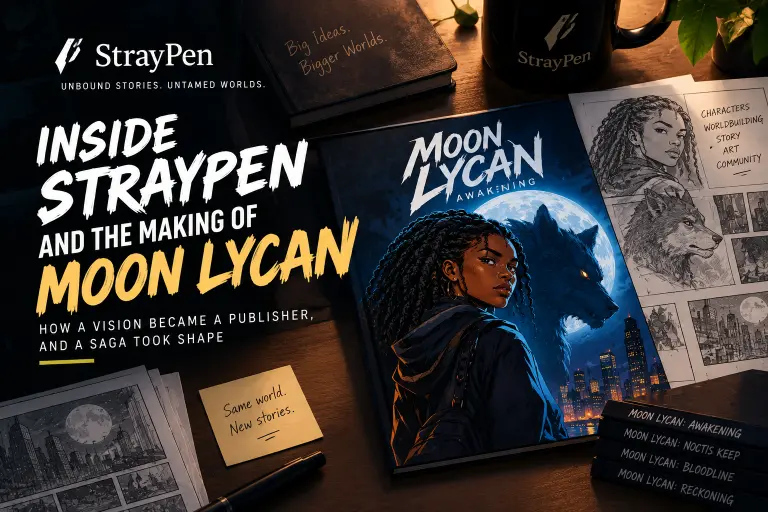
StrayPen is a current example of the type — a Black-owned independent publisher founded in 2025 by writer Yima Kange, built around three explicit pillars: urban fantasy, strong Black leads and cinematic storytelling. Its flagship series, Moon Lycan, is a supernatural action saga about legacy, family and an ancient conflict, released in instalments — Awakening and Noctis Keep are out now, with Bloodline and Reckoning announced. The house line is “Unbound stories. Untamed worlds.”
The reason to mention a publisher two years old alongside Image and DC is not that they are equivalent in scale. It is that this is where the pipeline starts now. The books that get talked about in five years are, statistically, sitting on somebody’s own website today with a mailing list of a few thousand people.
How to actually support the work
If you want more of these books to exist, the mechanics matter more than the enthusiasm:
- Buy direct where you can. The margin difference between a direct sale and a distributor sale is often the difference between a second issue and no second issue.
- Join the mailing list. For an independent publisher, the email list is the business. It is how print runs get sized and how launches get funded.
- Review it somewhere public. Goodreads, a store page, a post. Independent books have no marketing budget; discovery is entirely word of mouth.
- Buy the first issue, not the complete set. Early sales on issue one are the number that determines whether issue four exists.
The short version
The scarcity you have been experiencing is real, but it is a distribution problem, not a supply problem. The books are being made. They are just not arriving through the channels that comics have trained you to check.
Start with one independent publisher, get on their list, and buy one book direct. That is genuinely the whole method — and it is how the next decade of this genre gets funded.
StrayPen is an independent comic publisher building original supernatural worlds with cinematic scope. Browse the Moon Lycan series, or join the mailing list for a free digital comic.